
Navigation
DISCLAIMER:
The nowcast/forecast system and other analyses/data are research
products under development. No warranty is made, expressed or implied,
regarding accuracy, or regarding the suitability for any particular application. All rights reserved University of South Florida, Ocean Circulation Lab.
Copyright University of South Florida 2010
Red Tide Prediction and Tracking near Tampa Bay Watch
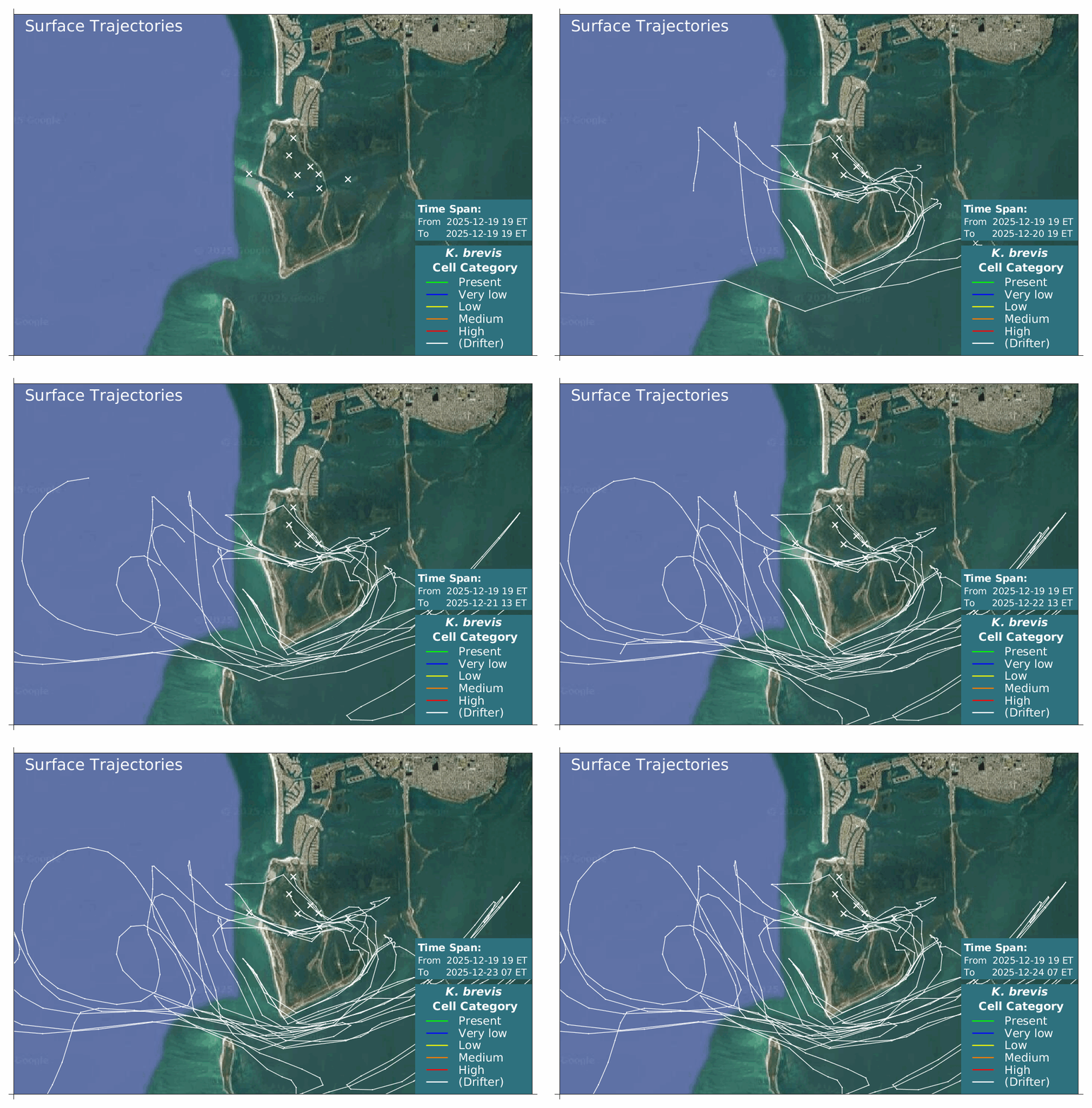
The "X" represents the starting point where each sample was collected. The lines show the 4.5 day trajectory for each sample. The color represents the red tide concentration for each sample. White lines represent simulated drifter trajectories. Please click here to go back to the TBCOM-based red tide tracking home page.
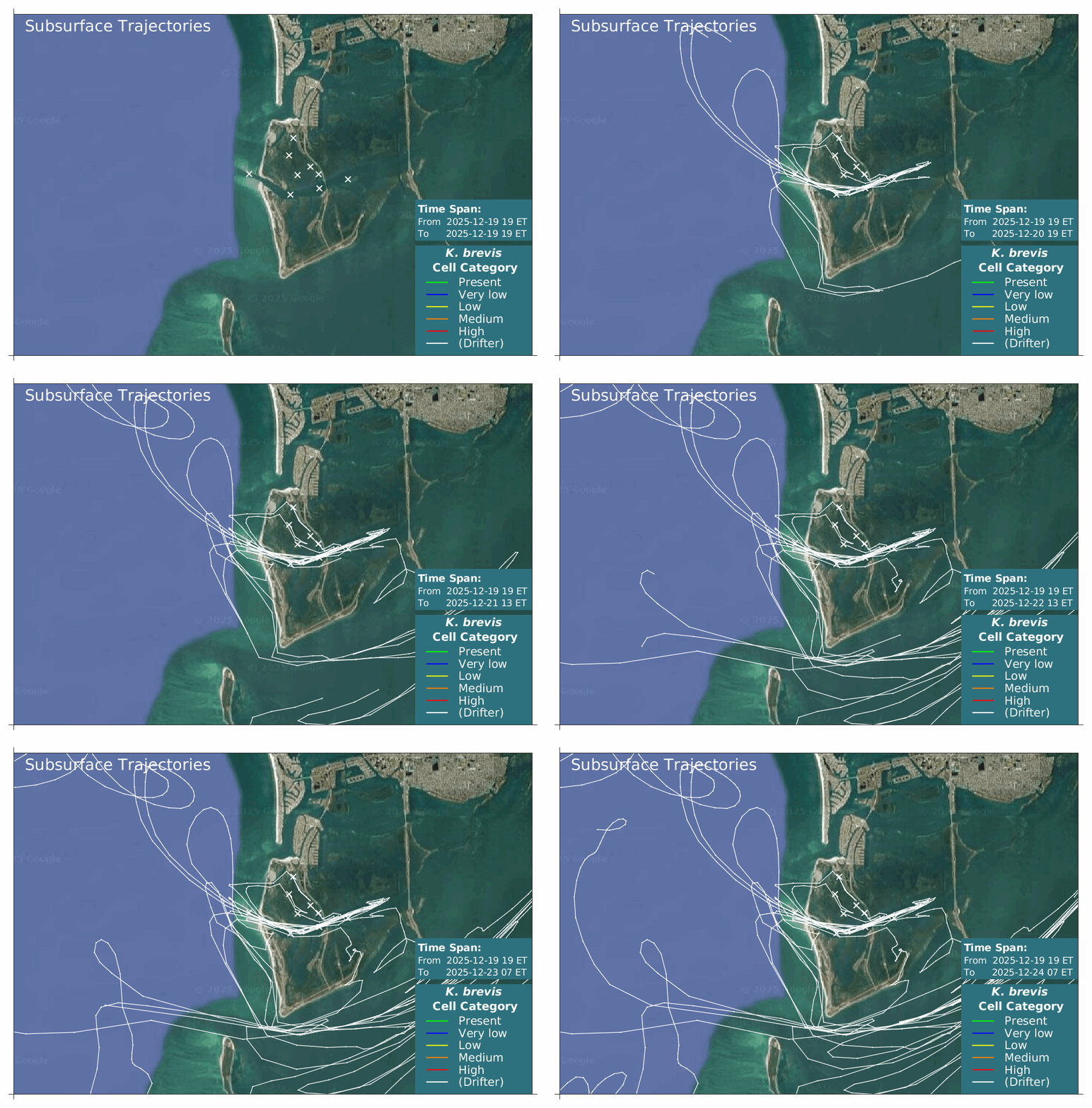
Once a bloom occurs, the Florida Wildlife Research Institute (FWRI) conducts K. brevis sampling and provides cell count observations to the CMS-USF team. The USF team then inputs these into an ocean circulation model to forecast where these cells may go over the next 4.5 days. With the cell counts a day old when received, the forecast consists of a 1-day hindcast followed by a 3.5-day forecast using our daily, automated Tampa Bay Coastal Ocean Model (TBCOM). The "X" represents the starting point where each sample was collected. The lines show the 3.5 day trajectory for each sample. The color represents the red tide concentration for each sample. White lines are not indicative of red tide; instead, they show where the current would take a simulated buoyant particle. These may be useful for search and rescue, or for tracking hazardous spills. The short-term red tide trajectory forecast products (surface and subsurface) are updated daily in early morning.
References:
Liu, Y., Weisberg, R.H., Zheng, L., Hubbard, K.A., Muhlbach, E.G., Garrett, M.J., Hu, C.,
Cannizzaro, J.P., Xie, Y., Chen, J., John, S., Liu, L.Y. (2023),
Short-term forecast of Karenia brevis trajectory on the West Florida Shelf,
Deep-Sea Research Part II, 212, 105335, https://doi.org/10.1016/j.dsr2.2023.105335
Liu, Y., Weisberg, R.H., Zheng, L., Heil, C.A., Hubbard, K.A. (2022),
Termination of the 2018 Florida red tide event: A tracer model perspective,
Estuarine, Coastal and Shelf Science, 272, 107901, https://doi.org/10.1016/j.ecss.2022.107901
Weisberg, R.H., Liu, Y., Lembke, C., Hu, C., Hubbard, K., Garrett, M. (2019), The coastal ocean circulation influence on the
2018 West Florida Shelf K. brevis red tide bloom, J. Geophys. Res. Oceans, 124, 2501-2512, https://doi.org/10.1029/2018JC014887.
Liu, Y., R.H. Weisberg, J.M. Lenes, L. Zheng, K. Hubbard, and J.J. Walsh (2016),
Offshore forcing on the "pressure point" of the West Florida Shelf: Anomalous upwelling and its influence on harmful algal blooms, J. Geophys. Res. Oceans,
121, 5501-5515, http://dx.doi.org/10.1002/2016JC011938.
Weisberg, R.H., L. Zheng, Y. Liu, A.A. Corcoran, C. Lembke, C. Hu, J.M. Lenes, and J.J. Walsh (2016),
Karenia brevis blooms on the West Florida Shelf: A comparative study of the robust 2012 bloom and the nearly null 2013 event, Cont. Shelf Res., 120, 106-121, http://dx.doi.org/10.1016/j.csr.2016.03.011.
Weisberg, R.H., L. Zheng, Y. Liu, C. Lembke, J.M. Lenes, and J.J. Walsh (2014),
Why no red tide was observed on the west Florida continental shelf in 2010, Harmful Algae, 38, 119-136, doi:10.1016/j.hal.2014.04.010.
Zheng, L.Y., and R.H. Weisberg (2012),
Modeling the west Florida coastal ocean by downscaling from the deep ocean, across the continental shelf and into the estuaries, Ocean Modell., 48, 10-29, doi:10.1016/j.ocemod.2012.02.002.
Acknowledgements
The FVCOM HAB tracking tool has benefited from several sources of funding beginning with the FWC and USF. Additional resources from ONR, NOAA and NASA have helped advance the modeling effort over the years. Current support is by NOAA/IOOS/SECOORA, NOAA/USF COMIT, NOAA/ECOHAB, State of Forida through FWC/FWRI, and Florida DEP.
HAB Tracking
-
[an error occurred while processing this directive]